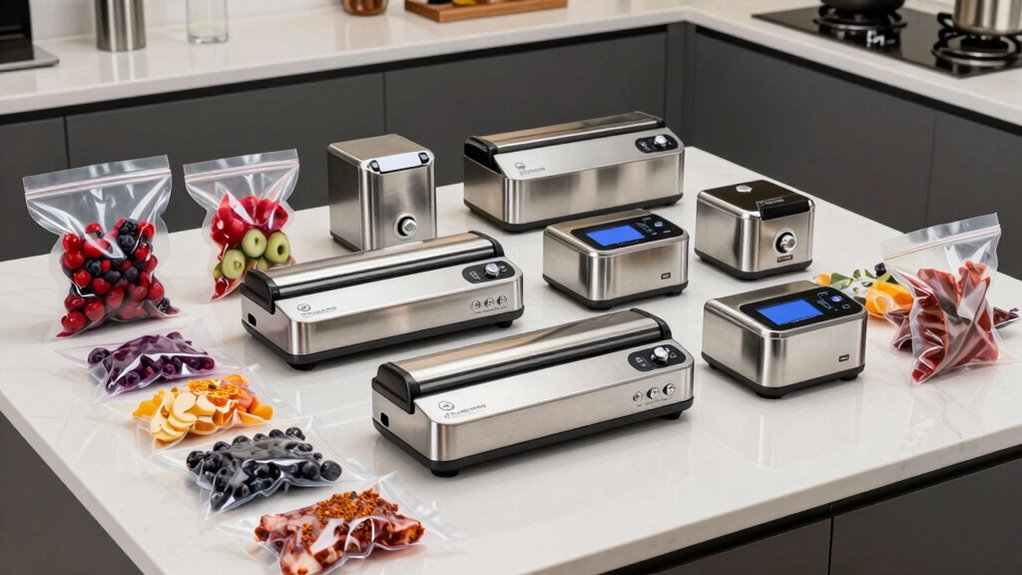

A chamber vacuum sealer works differently from the edge sealers most home kitchens use: the entire bag sits inside a chamber, so the machine can seal soups, marinades, and wet foods without sucking liquid into the pump. After comparing twelve models, the VacMaster VP230 stands out as the best overall pick thanks to its 1/2 HP oil pump and commercial-grade 12.25-inch seal bar, built for buyers who seal daily. For tighter budgets, the VEVOR 320W compact model delivers genuine chamber sealing at a fraction of the cost, while the Avid Armor USV32 strikes a strong middle ground for家庭 cooks who regularly portion liquids. The main tradeoff in this category is size and price versus pump durability and chamber capacity — larger chambers and oil pumps cost more and take up counter space, but they outlast and outperform the smaller dry-pump machines. Read on for the full breakdown.

Turn the school run and nap time into listening time
- Thousands of audiobooks, podcasts and originals
- Listen on your phone, tablet or Echo — also offline
- Cancel anytime
Complete the kit


Key Takeaways
- The VacMaster VP230 separates itself from every other pick with its oil-filled 1/2 HP pump, which is the only setup here rated for true daily commercial throughput.
- The three Avid Armor USV20 variants are nearly identical machines; the differences come down to bundled pouches and removable seal bars, so choose based on accessories rather than performance.
- The VEVOR lineup spans three wattages (260W, 320W, 380W), and the compact 260W model is the entry point while the 380W version closes the gap with pricier brands.
- Both Vesta Precision models offer auto vacuum time, a genuine convenience for beginners, but their smaller 5.6–8.1 quart chambers limit batch sizes.
- Chamber depth — not seal bar length — was the deciding factor for anyone sealing mason jars or tall cuts of meat; only the VacMaster and USV32 handle both comfortably.


More Details on Our Top Picks
Avid Armor USV20 Chamber Vacuum Sealer Machine – High-Volume 11.5” Sealer
This model earns the value slot because it delivers the core chamber-sealing benefit — full-chamber pressure that handles liquids and marinades — at a footprint and complexity level most home cooks can live with. The adjustable vacuum and seal controls let you dial back pressure for delicate items, something the entry-level VEVOR 260W compact model doesn’t offer. Compared with the Ultra Series version of this same machine, you give up the bundled pouches but keep the identical 11.5-inch sealing bar and 4L chamber. The tradeoff is real, though: the 11×10-inch pouch ceiling means long roasts or whole briskets won’t fit, and at 17.55 pounds this isn’t a machine you’ll shuffle in and out of a cabinet.
Pros:- Seals liquids and moist foods reliably thanks to full-chamber pressure
- Adjustable vacuum and seal settings for delicate or dense items
- Spacious 4L chamber handles large portions
- Countertop-friendly dimensions for a chamber machine
Cons:- Pouch size capped at 11×10 inches, excluding oversized cuts
- Heavier than suction-style sealers, so it lives on the counter
Best for: Home cooks doing regular sous vide prep, batch freezing, and soup storage who want chamber-grade liquid sealing without a commercial price tag
Not ideal for: Hunters or small-batch processors — the 11×10-inch pouch limit rules out large cuts that the VacMaster VP230 handles easily
- Chamber Capacity:4L
- Sealer Width:11.5 inches
- Pouch Size Compatibility:Up to 11×10 inches
- Heating Bar:11.5 inches
- Dimensions:14″W x 12″D x 8.25″H
- Weight:17.55 lbs
Our verdict“The smartest entry point for buyers who want true chamber performance for liquids and sous vide without paying commercial money.”
Avid Armor USV20 Ultra Series Chamber Vacuum Sealer with Removable 11.5-Inch Bar and 300 BPA-Free Pouches
What separates this from the standard USV20 isn’t the machine — it’s the 300 BPA-free pouches in three sizes that arrive in the box. For a first-time chamber sealer buyer, that matters more than it sounds: chamber machines use smooth-walled pouches, not the embossed bags suction sealers take, so a new owner without the bundle is stuck ordering supplies before sealing anything. The removable 11.5-inch bar also simplifies cleanup after messy, liquid-rich jobs, an advantage over the fixed-bar VEVOR compact. Against the DualCore CVS101, you lose app connectivity and the bigger 6L chamber, but you also skip a steep learning curve. The tradeoffs: it still demands counter space, and the bar assembly needs routine maintenance to keep seals airtight.
Pros:- Includes 300 BPA-free pouches across three practical sizes
- Leak-proof sealing proven with liquids and moist foods
- Removable sealing bar simplifies cleaning
- Pouch variety suits freezer storage, sous vide, and meal prep out of the box
Cons:- Bulky footprint for small kitchens
- Requires regular bar and gasket maintenance to sustain performance
Best for: First-time chamber sealer owners who want to start sealing soups, meats, and freezer meals the day the box arrives
Not ideal for: Buyers who already own a stock of chamber pouches — the bundle’s value largely disappears, making the standard USV20 the smarter buy
- Sealing Technology:Leak-proof chamber sealing
- Bar Length:11.5 inches, removable
- Included Pouches:300 BPA-free
- Pouch Sizes:6×10″, 8×10″, 11×10″
- Pouch Thickness:3.5 mil
Our verdict“The low-friction way into chamber sealing — everything you need for months of use ships together.”
VEVOR Chamber Vacuum Sealer, 320W Sealing Power, Compact Food Packing Machine
This VEVOR sits in a useful middle ground: more muscle than the compact 260W VEVOR, far less mass than the 89-pound VacMaster VP230. The 100KPa vacuum strength translates to visibly tighter seals and longer freezer life for bulk meats, and the real-time pressure gauge means you can watch each cycle complete instead of guessing — a practical edge over the Avid Armor USV20 when you’re sealing varied loads back to back. The 12.6-inch sealing length also edges out the USV20’s 11.5-inch bar, fitting wider pouches for family-size portions. The tradeoffs are honest ones: 320W draws more power than casual users need, and the stainless chassis, while rust-resistant, eats counter space that a compact kitchen can’t spare.
Pros:- 100KPa vacuum power produces tight, long-lasting seals
- Deep stainless steel chamber fits large and bulky items
- 12.6-inch sealing length handles wider pouches than most rivals
- LED display and pressure gauge make cycles transparent
Cons:- Bulky footprint dominates smaller counters
- Higher power consumption than compact alternatives
Best for: Bulk shoppers and large households processing big batches of meat, wet foods, and freezer staples weekly
Not ideal for: Apartment dwellers sealing occasionally — the size and power draw outweigh the capacity benefits for light use
- Power:320W
- Vacuum Power:100KPa
- Sealing Length:12.6 inches
- Chamber:Deep chamber for large items
- Material:Stainless steel
- Voltage:110V
Our verdict“A workhorse for high-volume home sealing that splits the difference between kitchen-friendly and commercial-grade.”
DualCore CVS101 Chamber Vacuum Sealer for Liquids & Sous Vide
This is the pick for buyers who want their sealer to do more than cycle and seal. The dual vacuum zones allow gentler programs for powders and delicate items alongside full-strength pulls for dense meats — flexibility neither the Avid Armor USV20 nor the VEVOR 320W offers. The 6L chamber is the largest in this batch, and the marinate mode plus external jar port expands the machine from a freezer tool into a genuine prep station. App connectivity for tracking seals rounds out the package. The costs are equally clear: the control scheme carries a real learning curve compared with one-dial models, and despite commercial-grade branding, it’s built for home and light-commercial duty — a weekend farmer’s market yes, a production line no.
Pros:- Largest chamber in the lineup at 6L, handling liquids and powders
- Dual vacuum zones suit both delicate and dense foods
- -100kPa vacuum strength extends preservation times
- Marinate mode and external jar port add real prep-kitchen versatility
Cons:- Complex controls demand a learning curve
- Bulkier than compact models for small kitchens
- Not rated for true industrial throughput
Best for: Tech-comfortable cooks who want marinade modes, jar sealing, and app tracking alongside core vacuum sealing
Not ideal for: Buyers who want a simple seal-and-go machine — the layered controls will feel like overhead, not a feature
- Chamber Capacity:6L
- Vacuum Zones:Dual
- Vacuum Strength:-100kPa
- Sealing Bar Length:12 inches
- Power:230W
- Bag Compatibility:Various sizes including embossed rolls
- Additional Features:Liquid-safe marinate mode, external jar port, app connectivity
Our verdict“The most versatile machine here for cooks who treat vacuum sealing as part of a broader prep workflow.”
VacMaster VP230 Chamber Vacuum Sealer – Commercial Food Sealer with 1/2 HP Oil Pump
When sealing volume is the job, this is the machine for it. The 1/2 HP oil pump is the defining difference: oil pumps sustain duty cycles that dry-piston machines like the DualCore CVS101 or Avid Armor USV20 simply can’t match, which is why delis, hunters, and meal-prep businesses keep landing on the VP230. The double seal system adds a second weld line on every bag — cheap insurance for long freezer storage and sous vide baths where a single failed seal ruins the cook. The 12.25-inch bar and 12×15-inch max bag swallow cuts the smaller machines can’t physically fit. In exchange, you accept an 89-pound chassis that needs a dedicated station, and the oil pump carries ongoing maintenance the plug-and-play models avoid.
Pros:- Heavy-duty 1/2 HP oil pump built for continuous commercial cycles
- Double seal on every bag for maximum shelf life
- 12.25-inch bar and 12×15-inch bags fit large cuts and whole batches
- Handles liquids, marinating, and sous vide without fuss
Cons:- 89-pound weight makes relocation a two-person job
- Requires ample dedicated counter or bench space
- Oil pump adds long-term maintenance obligations
Best for: Small food businesses, hunters, and high-volume processors who seal dozens of bags daily and need sustained duty cycles
Not ideal for: Home users sealing a few bags a week — the size, weight, and oil-pump upkeep are wasted capacity at that volume
- Pump:Heavy-duty 1/2 HP oil pump
- Seal Bar:12.25 inches with double seal
- Chamber Size:12.5″ x 15″ x 5″
- Maximum Bag Size:12″ x 15″
- Overall Dimensions:15.5″ x 19″ x 15.75″
- Weight:89 lbs
Our verdict“A genuine commercial machine that justifies its footprint the moment sealing becomes daily work rather than occasional convenience.”
Avid Armor USV20 Ultra Series Chamber Vacuum Sealer Machine with 11.5-Inch Bar for Wet Foods & Meat
Among chamber sealers, the USV20 Ultra Series stands out for its focus on moist foods — soups, braises, marinated meats, and anything a suction sealer would choke on. The 11.5-inch seal bar handles wide pouches, and the adjustable vacuum and seal times let you dial in settings for delicate liquids versus dense cuts of meat. Compared with the Gasbye CV4520, which keeps things simpler, the USV20’s marinate function and accessory hose make it the more versatile pick for cooks who rotate between wet and dry jobs. The tradeoff is the Oxford fabric housing rather than full stainless steel like the VEVOR 380W, and it demands regular maintenance to keep seals consistent over time.
Pros:- Leak-proof sealing performance specifically strong with wet and juicy foods
- Auto Vac & Seal plus marinate mode in one machine
- Reversible dust cover and sample pouches included out of the box
- Adjustable vacuum and seal times for fine-tuning delicate items
Cons:- Oxford fabric build is less durable than full stainless steel competitors
- Requires regular maintenance for consistent long-term performance
- Priced above basic entry-level chamber sealers
Best for: Home cooks who regularly seal liquids, sauces, and marinated proteins and want adjustable control
Not ideal for: Buyers wanting a set-and-forget stainless workhorse — the fabric housing and manual maintenance routine require more attention
- Sealing Technology:Chamber vacuum
- Seal Bar Length:11.5 inches
- Functions:Auto Vac & Seal, Marinate
- Material:Water-resistant Oxford fabric
- Included Accessories:Dust cover, vacuum pouch samples, accessory hose
- Additional Features:Reversible dust cover, adjustable vacuum/seal time
Our verdict“This pick makes the most sense for liquid-heavy food prep where suction sealers fail and adjustable control matters more than a steel shell.”
Vesta Precision 12” Chamber Vacuum Sealer, 8.1 Qt, Auto Vacuum Time
The Vesta Precision 8.1 Qt is the most refined machine in this batch. Its intelligent auto vacuum control removes the guesswork that cheaper models like the VEVOR 380W leave to manual timers, adjusting the cycle automatically whether you’re sealing a tender fillet or a jar of stock. The soft-close glass lid with damping feels like a commercial appliance, and the 8.1-quart chamber is roomier than the Gasbye’s 5.3 quarts, accommodating bulky roasts with ease. Universal jar sealing adapters add genuine value for canning-adjacent storage. The cost of that polish is literal: this is the priciest tier of the lineup, the footprint demands serious counter real estate, and newcomers may face a learning curve before the smart features pay off.
Pros:- Automatic vacuum control eliminates timer guesswork entirely
- 8.1-quart chamber handles bulky cuts and large batches
- Soft-close glass lid and stainless build feel genuinely commercial-grade
- Universal jar sealing adapters expand storage options beyond bags
Cons:- Most expensive tier — smart features come at a real premium
- Large footprint requires dedicated counter space
- Feature set has a learning curve for first-time chamber sealer owners
Best for: Serious home chefs and small commercial kitchens wanting automated precision and large capacity
Not ideal for: Casual sealers or tight counters — the premium price and large footprint outweigh the smart features for occasional use
- Chamber Size:12.3″W x 12.8″L x 3.7″H
- Capacity:8.1 Qt
- Lid:Soft-close glass with damping
- Pump:Variable Frequency Pump
- Jar Sealing:Universal adapters included
- Material:Stainless steel
Our verdict“This model is better suited to buyers who want automation and capacity to match frequent, varied sealing rather than occasional weekend use.”
VEVOR Chamber Vacuum Sealer, 380W Pump Power, Sealing Bag Packing Machine
If raw sealing muscle is the priority, the VEVOR 380W delivers the strongest pump in this batch, pulling over -95 kPa of vacuum at 90 L/min. That translates into faster cycle times when you’re processing dozens of bags of game meat or batch-cooked meals — something the smaller Gasbye CV4520 can’t match in throughput. The 304 stainless steel body and spacious 12.87-inch-wide chamber put it in light-commercial territory, closer in spirit to the VacMaster VP230 than to home-focused units like the Avid Armor USV20 Ultra. The compromises are familiar for this class: it eats counter space, and the array of manual controls assumes you’re willing to learn the machine rather than have it think for you the way the Vesta Precision does.
Pros:- 380W pump with 90 L/min rate delivers the fastest cycles in this batch
- Vacuum degree over -95 kPa produces exceptionally tight seals
- 304 stainless steel chamber and body built for heavy repeat use
- Adjustable vacuum and seal times cover a wide range of food types
Cons:- Large footprint demands substantial dedicated counter space
- Manual control complexity creates a real learning curve for newcomers
Best for: Hunters, batch cookers, and small operations who prioritize sealing speed and throughput
Not ideal for: First-time users wanting automation — the manual controls and industrial design assume experience
- Power:380W
- Vacuum Pump Rate:90 L/min
- Vacuum Degree:over -95 kPa
- Chamber Dimensions:12.87 x 12.20 x 3.15 inches
- Sealing Length:11.5 inches
- Material:304 stainless steel
- Included Components:Accessories kit, chamber vacuum sealer
Our verdict“This pick makes the most sense for high-volume sealing where pump power and cycle speed matter more than smart features or compact size.”
Avid Armor USV32 Chamber Vacuum Sealer Machine for Foods, Soups & Liquids
The USV32 splits the difference between home convenience and professional capability better than anything else here. Its one-touch operation is simpler than the VEVOR 380W’s manual dial-in approach, yet its stainless chamber and dual-wire seal bar are built for the kind of volume — whole freezers of soup, a season’s worth of game — that would wear out a budget machine. The rapid marinade mode is a genuine time-saver compared with the standard marinate function on the USV20 Ultra, cutting flavor-infusion time when prepping proteins in quantity. Compared with the Vesta Precision, you lose auto vacuum control and the glass lid, but you gain a more straightforward, high-throughput workflow. The vague warranty situation is the main hesitation for heavy users.
Pros:- One-touch operation delivers consistent seals without settings fiddling
- Dual-wire 11.5-inch seal bar creates redundant, reliable seals on full bags
- Stainless steel chamber withstands high-volume professional-style use
- Rapid marinade mode noticeably cuts prep time for flavor-infused foods
Cons:- Costs well above basic entry-level vacuum sealers
- Large footprint competes with full-size appliances for counter space
- No clearly specified warranty, a concern for longevity-minded buyers
Best for: Hunters, gardeners, and bulk meal-preppers who process large quantities and value simple one-touch speed
Not ideal for: Buyers who want documented warranty coverage and automation — the unspecified warranty and manual workflow leave gaps
- Brand:Avid Armor
- Model Number:USV32
- Chamber Size:11.5 inches
- Material:Stainless steel
- Sealing Bar:Dual-wire, 11.5 inches
- UPC:704438510574
Our verdict“This option stands out for volume processors who want near-commercial durability with the easiest operation in the lineup.”
Gasbye Chamber Vacuum Sealer – 5.3QT Large Chamber, Replaceable 11.5″ Sealing Bar with Double Seal, Includes 30 Pre-Cut Vacuum Bags
The Gasbye CV4520 wins on out-of-the-box readiness: 30 pre-cut bags, a filler plate, and an external suction hose arrive in the box, so you can start sealing the same afternoon. Its 5.3-quart chamber is smaller than the Vesta Precision’s 8.1 quarts, but that compactness suits first-time chamber sealer owners testing the waters. The standout long-term feature is the replaceable sealing bar and heating wires — a design choice usually reserved for pricier commercial units like the VacMaster VP230, meaning a worn wire doesn’t end the machine’s life. The double seal adds confidence for liquids. Compared with the Avid Armor USV32, you give up marinade modes and heavy-duty throughput, and the machine still costs more than suction sealers — a poor fit if you only store dry goods.
Pros:- Complete starter package with 30 bags, filler plate, and suction hose included
- Replaceable sealing bar and heating wires extend the machine’s usable lifespan
- Double-seal bar produces bubble-free, leak-proof seals on liquids
- 3-year warranty — longer documented coverage than the Avid Armor USV32
Cons:- Higher cost than traditional suction sealers with no advantage for dry-only storage
- 5.3-quart chamber limits batch size for bulk processors
- Footprint still larger than most countertop appliances
Best for: First-time chamber sealer buyers who want everything included and a clear 3-year warranty backing the purchase
Not ideal for: Dry-goods-only storage or high-volume processors — chamber bags cost more over time and the smaller chamber limits batch size
- Brand:Gasbye
- Model Number:CV4520
- Chamber Capacity:5.3 QT
- Sealing Bar Length:11.5 inches
- Chamber Width:9.7 inches
- Included Components:External air suction hose, filler plate, power cord, 30 vacuum bags
- Warranty:3 years
Our verdict“Compared with similar options, this is the smartest entry point for beginners who want repairability and included supplies without paying for commercial muscle.”
VEVOR Chamber Vacuum Sealer, 260W, Compact Size with 10.2-inch Sealing Length
I’d put the VEVOR 260W Compact Chamber Vacuum Sealer in the lane for buyers who want a sturdy, no-frills chamber without stepping into a full commercial footprint. Its 100KPa vacuum rating and stainless steel chamber matter because repeated sealing of moist foods can expose weaker builds to rust and wear. The built-in gauge helps users watch pull-down, which is useful when learning how different foods react. Compared with the Vesta Precision 12” Chamber Vacuum Sealer, this model gives up accessory breadth and a wider 12-inch seal path, but it keeps the pitch simpler. The deep chamber accepts taller bags, yet the 10.2-inch seal length limits wide portions. Counter space and a short learning curve remain the main costs.
Pros:- Strong 100KPa vacuum pull for extended food storage
- Stainless steel chamber holds up better under frequent use
- Deep chamber handles taller bags and bulky items
- LED controls and built-in gauge make operation easier to learn
Cons:- The 10.2-inch seal path is limiting for wide portions
- Its chamber-style body still demands real counter or storage space
- New users need some familiarity with chamber sealing behavior
Best for: Home preservers who want a sturdy chamber for tall bags, moist foods, and occasional bulk sealing.
Not ideal for: Buyers sealing wide 12-inch bags or wanting jar-sealing accessories out of the box.
- Sealing Power:260W
- Vacuum Power:100KPa
- Sealing Length:10.2 inches
- Chamber Style:Deep stainless steel chamber
- Built-in Gauge:Yes
- Controls:LED display
Our verdict“This pick suits buyers who want a compact stainless chamber for tall bags and occasional bulk sealing.”
Vesta Precision 12” Chamber Vacuum Sealer, 5.6 Qt with Auto Vacuum Control and Mason Jar Sealing Kit
I’d place the Vesta Precision 12” Chamber Vacuum Sealer ahead for buyers who care about control with liquids, sauces, and jar sealing. The auto vacuum control helps dial in the pull-down, which reduces the chance of soups boiling over inside the chamber. Its 5.6-quart chamber and 12.3-inch width give it more practical room than the VEVOR 260W Compact Chamber Vacuum Sealer, while the washable seal bar and removable chamber make cleanup after wet foods less tedious. The included mason jar kit broadens preservation beyond pouches, and the soft-close lid adds a nicer daily feel. The tradeoff is complexity: casual users may face more parts and settings than they want, and the machine needs a dedicated storage spot.
Pros:- Auto vacuum control gives more command over liquid-heavy sealing
- Removable chamber and washable seal bar simplify cleanup
- Included mason jar kit expands preservation beyond pouches
- Soft-close lid and stainless build improve everyday handling
Cons:- The setup and accessory set may feel involved for casual users
- Its size requires a dedicated storage or counter area
- More parts and modes create a steeper learning curve
Best for: Sous vide cooks and preservationists who seal liquids, sauces, and mason jars.
Not ideal for: Casual users who want a simple machine with minimal parts and storage demands.
- Chamber Capacity:5.6 qt
- Chamber Dimensions:12.3″W x 8.8″L x 3.7″H
- Auto Vacuum Control:Yes
- Included Components:Chamber vacuum sealer, CleanTray, seal bars, flat vac bags, mason jar sealing kit, vacuum hose, power cord
- Model Number:V513
- Seal Bar:Washable
- Chamber:Removable
- Lid:Soft-close
Our verdict“This is the better fit for liquid-heavy sealing and jar preservation when setup complexity is acceptable.”

How We Picked
I ranked these twelve sealers on five factors that actually change the buying decision: pump type and durability (oil pumps versus dry pumps, and what that means for lifespan), chamber size (which determines what fits inside — from flat steaks to mason jars), seal bar length and quality (double seals and replaceable bars matter for wet foods), ease of use (auto vacuum time versus manual timing, bag positioning), and versatility across food types, especially liquids and sous vide prep. Because several models in this lineup are close cousins — three VEVOR variants and three Avid Armor USV20 configurations — I treated accessory bundles and wattage differences as tiebreakers rather than reasons for separate rankings.
The ranking logic favors long-term ownership over sticker appeal. A machine with a robust pump and generous chamber earns a higher spot even when a cheaper compact model is easier to store, because chamber sealers are a buy-once category for most owners. Where a smaller machine genuinely wins — apartments, occasional users, first-time buyers — I placed it accordingly and said so explicitly.
Factors to Consider When Choosing Chamber Vacuum Sealer
Chamber vacuum sealers range from compact countertop units to near-commercial workstations, and the wrong choice is usually about mismatched expectations, not bad machines. These are the factors that actually separate a satisfying purchase from an expensive paperweight.Pump Type: The Decision That Outlives Everything Else
Chamber sealers use either dry piston pumps or oil-filled rotary pumps, and this single difference drives most of the price spread in this category. Oil pumps, like the VacMaster’s 1/2 HP unit, run cooler, pull deeper vacuum, and survive thousands of cycles with only occasional oil changes — which is why commercial kitchens pay the premium. Dry pumps, found on the VEVOR and Avid Armor compact models, are sealed and maintenance-free but have a finite lifespan under daily use. A common mistake is buying a dry-pump machine and running it eight hours a day processing game meat or meal-prep batches; it will die early. If you seal more than a few times a week, budget for oil. If you seal monthly, a dry pump is the smarter spend.
Chamber Size: Measure Before You Buy
The chamber’s internal dimensions — especially height and depth — dictate what you can actually seal, and this is where buyers most often guess wrong. Chamber capacity here ranges from about 5.3 to over 8 quarts, and an inch of missing height is the difference between sealing a mason jar or not. People see an 11.5-inch seal bar and assume large capacity, but bar length only governs bag width. Before choosing, measure the tallest and widest items you seal regularly: whole briskets, wide fish fillets, and soup-filled bags all need different clearances. A slightly oversized chamber is never wasted; an undersized one forces awkward two-bag workarounds immediately.
Seal Bar Quality and Double Sealing
The seal bar is the wear item on any chamber sealer, and its design determines both bag compatibility and long-term repair costs. A replaceable sealing bar with double seal capability, like the Gasbye’s, produces two parallel welds on every cycle — a genuine safety margin for liquid-heavy bags destined for sous vide, where a single weak seal can fail mid-bath. Fixed bars that cannot be swapped mean the whole machine ages out when the bar wears. Also check the maximum bag thickness supported; thinner bars struggle with heavy 3-mil or embossed pouches. This is a quiet spec that rarely appears on the listing page, so verify it with the manufacturer before committing.
Automation and Learning Curve
Manual vacuum-time controls are standard on budget chambers, and they demand a learning period: set the time too short and you get weak vacuum, too long and you waste cycles or damage soft foods. Auto vacuum time, offered on both Vesta Precision models, senses when the target vacuum level is reached and stops on its own — a real quality-of-life upgrade for beginners and anyone sealing varied foods back to back. Experienced users often prefer manual control because it is faster to tweak per batch. Match the control scheme to your patience level, not to spec-sheet ambition. The most expensive machine with manual-only controls can frustrate a casual user more than a modest auto machine.
Ongoing Bag Costs Are the Hidden Expense
Chamber sealers use smooth, non-embossed pouches that cost a fraction of what edge sealers require — but you are still buying bags forever, and chamber size determines which pouches fit. Bundled starter pouches, like the 300-count included with one Avid Armor USV20 configuration, effectively subsidize the first months of ownership, which is why near-identical machines can differ meaningfully in real value. Check pouch availability in the sizes your chamber accepts before buying an obscure brand, because proprietary or hard-to-find bag sizes turn into a long-term annoyance. Buying pouches in bulk rolls and cutting to length is the cheapest path once you know your typical bag dimensions.
Footprint, Weight, and Counter Reality
Chamber sealers are heavy and permanent-feeling: the commercial models in this lineup weigh enough that they effectively live wherever you first set them down. Before choosing, decide honestly whether this machine gets dedicated counter space, a rolling cart, or shelf storage — because a 40-plus pound unit hauled from a cabinet gets used far less than owners expect. Compact models like the VEVOR 260W trade chamber size for grab-and-go practicality, which is a fair deal for small kitchens. Also check lid clearance; a top-hinged lid needs vertical headroom that under-cabinet placements rarely allow. The best sealer is the one you will actually pull out on a Tuesday night.
Frequently Asked Questions
Can a chamber vacuum sealer really seal liquids like soup without failure?
Yes, and this is the core reason to buy one over an edge sealer. Because the whole bag sits inside the chamber and pressure drops equally inside and outside the bag, liquid never gets forced toward the pump — the liquid simply stays put while the air around it evacuates. Models like the Avid Armor USV32 and DualCore CVS101 are explicitly built around this strength, handling soups, sauces, and marinades that would flood a suction sealer. Two precautions still apply: fill bags no more than two-thirds full so liquid stays clear of the seal area, and use a double-seal bar for anything going into a long sous vide bath. Expect slight bubbling of liquids at full vacuum, which is normal boiling at room temperature, not a malfunction.
Why are the three Avid Armor USV20 listings so similar, and which one should I pick?
The USV20 is fundamentally one machine sold in different configurations, so the choice comes down to accessories rather than performance. One configuration includes 300 BPA-free pouches, which covers months of typical home use and makes it the strongest value if you are starting from zero. Another features a removable 11.5-inch seal bar, which matters if you eventually want to swap a worn bar or upgrade to a double-seal bar instead of replacing the machine. If neither accessory matters to you, pick whichever configuration costs less at purchase time, because the pump, chamber, and sealing performance are the same. Do not pay twice for the Ultra Series name expecting a performance tier that does not exist.
Is a commercial model like the VacMaster VP230 overkill for home use?
It depends entirely on volume. If you seal a few bags a week for leftovers, the VP230’s 1/2 HP oil pump and oversized 12.25-inch seal bar are more machine than you need, and its footprint and weight will dominate a home kitchen. But if you process garden harvests, break down bulk meat purchases, run a small food business, or sous vide nightly, the oil pump’s durability becomes the whole point — dry-pump machines in this lineup simply are not rated for that duty cycle. The other hidden benefit is repairability: oil pumps can be serviced rather than replaced. A reasonable rule of thumb is that beyond roughly ten sealing cycles per week, the commercial build stops being overkill and starts being insurance.
Which of these sealers can I use with mason jars, and does it need extra accessories?
Chamber sealing into mason jars requires two things: enough internal chamber height to stand the jar upright with the lid assembly attached, and a jar-sealing lid insert. Among this lineup, the Vesta Precision 5.6-quart model ships with a mason jar sealing kit, making it the turnkey choice for jar work, while the VacMaster VP230 has the chamber height to handle standard jars with a separately purchased lid kit. The compact VEVOR models generally lack the vertical clearance for anything but the shortest jars, so verify internal chamber height against your jar size before assuming compatibility. Jar sealing is excellent for dry goods, spices, and leftovers you want to re-open repeatedly without cutting a bag.
What maintenance does a chamber vacuum sealer need to stay reliable?
Dry-pump machines like most of the VEVOR and Avid Armor units are effectively maintenance-free on the pump side, but you should still wipe the chamber dry after liquid-heavy sessions and check the seal bar for food debris, which is the leading cause of weak or incomplete seals. Oil-pump machines like the VacMaster add two real tasks: monitoring the oil sight glass and changing the pump oil periodically, especially after heavy liquid-adjacent work. Replace the Teflon strip covering the seal wire when it discolors or scorches — it is a cheap part that protects bag weld quality. Owners who skip these small habits are the ones writing off machines early; chamber sealers are mechanically simple and reward ten minutes of attention per month.
Conclusion
For most buyers who have decided a chamber vacuum sealer is worth the counter space, the VacMaster VP230 is the best overall choice — its oil pump and 12.25-inch seal bar simply outclass the rest of this lineup for durability and capacity, provided you have the room and budget. The VEVOR 320W compact model takes best value, delivering genuine chamber sealing for wet foods at an accessible price, with the 260W version as the pick for the smallest kitchens. Best premium honors go to the Avid Armor USV32, whose larger chamber makes it the sweet spot for serious home cooks sealing soups and liquids in volume. Beginners should start with the Vesta Precision auto-vacuum models, whose set-and-forget operation removes the learning curve entirely, and the Gasbye with its double replaceable seal bar is the niche pick for sous vide enthusiasts who cannot tolerate a failed seal. Choose by duty cycle first, chamber size second, and price last — in that order, the right machine becomes obvious.