
To create a successful science fair project, start by developing a clear research question focused on your main topic. Design an organized experiment with controlled variables and multiple trials to guarantee reliable results. Collect and analyze data carefully, looking for trends and patterns. Keep detailed records of your procedures and findings, then use visuals to present your results. If you continue, you’ll discover how to refine your project and confidently share your science story.
Key Takeaways
- Define a clear research question and plan experiments with controlled variables for reliable results.
- Organize multiple trials and systematically record data using charts or tables.
- Analyze results for patterns, trends, and support for the hypothesis using basic statistics.
- Document procedures, observations, and findings thoroughly for reports and presentations.
- Critically evaluate data, address errors, suggest improvements, and communicate findings effectively.
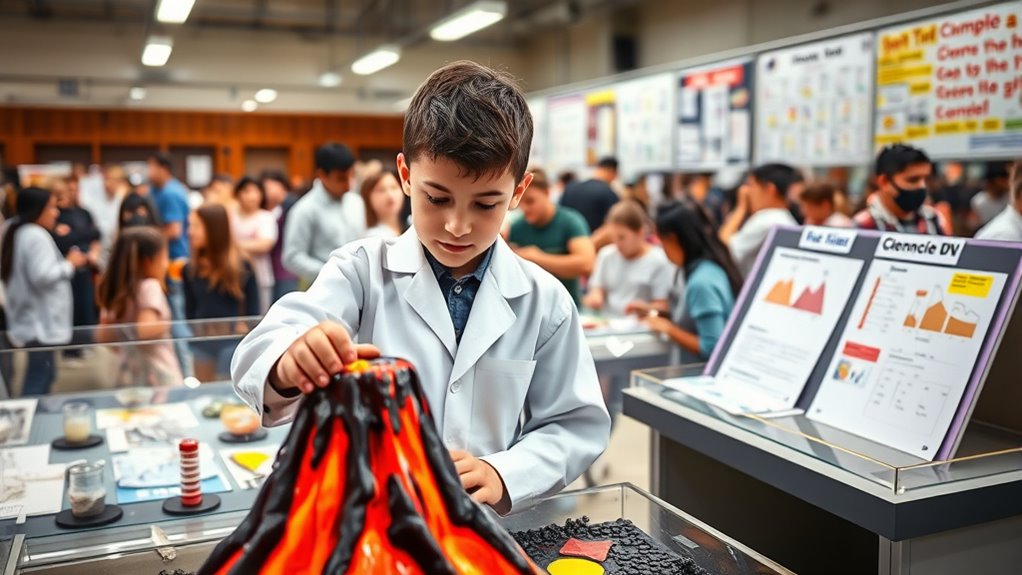
Participating in a science fair can be an exciting yet challenging experience, but with the right preparation, you can make it a success. The first step is to develop a clear, focused research question. Once you’ve identified your topic, you need to plan your experimental design carefully. This involves deciding what variables you’ll test, how you’ll control other factors, and what materials you’ll need. A well-structured experimental design ensures that your experiment will produce reliable and valid results. Think about how many trials you’ll conduct to account for variability and how you’ll organize your observations to keep everything consistent.
Start your science fair project by developing a clear research question and planning your experimental design carefully.
As you set up your experiment, pay close attention to data collection. Accurate data analysis is essential for drawing meaningful conclusions. You should record your observations systematically, using charts or tables to track your results over multiple trials. When analyzing your data, look for patterns or trends that support or refute your hypothesis. Using basic statistical methods, like calculating averages or percentages, can help clarify your findings. Remember, good data analysis not only helps you interpret your results but also strengthens the credibility of your project when presenting it.
Throughout the process, stay organized. Keep detailed notes of your experimental procedures, data, and any adjustments you make along the way. This documentation will be invaluable when writing your report or preparing your presentation. It also shows judges that you understand each step of the scientific process. Be prepared to explain your experimental design and data analysis methods clearly. Practice presenting your project in a way that highlights how you formulated your question, designed your experiment, and analyzed the results.
In addition to technical accuracy, focus on communicating your findings effectively. Use visuals like graphs or charts to illustrate your data, making it easier for judges and viewers to grasp your conclusions. When discussing your experiment, emphasize how your data supports your hypothesis or what surprises you discovered. Address potential sources of error and suggest ways to improve your experiment in the future. This demonstrates critical thinking and a thorough understanding of your project. Additionally, incorporating Powerful persuasive words can enhance your presentation and make your findings more compelling.
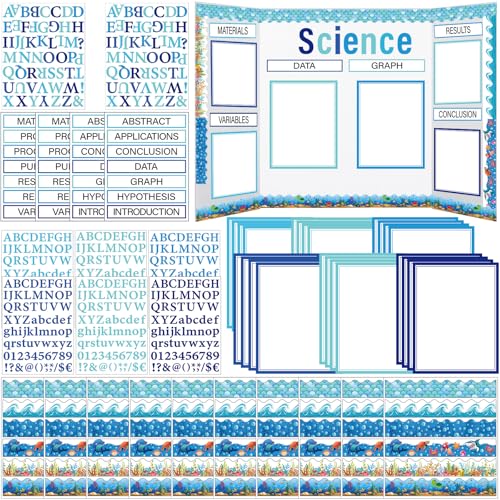
96 Pcs Science Fair Board Supplies Includes Self Adhesive Science Fair Project Titles Subtitles Presentation Bulletin Border Letter Stickers First Day of School Back Classroom(Ocean Style)
Comprehensive Science Fair Board Supplies: Without Science fair board! You will receive 96 sheets of science fair board…
As an affiliate, we earn on qualifying purchases.
As an affiliate, we earn on qualifying purchases.
Frequently Asked Questions
How Do I Choose an Appropriate Science Fair Project Idea?
To choose an appropriate science fair project idea, start with brainstorming techniques like mind mapping or listing your interests. Narrow down options by idea validation—ask yourself if the project is feasible, interesting, and answers a meaningful question. Focus on topics you’re passionate about, and guarantee your idea can be realistically completed with available resources and time. This approach helps you pick a project you’ll enjoy and can confidently present.
What Are Common Mistakes to Avoid During Project Execution?
Imagine your project as a delicate clay sculpture—you want it to hold its shape. Avoid data misinterpretation by double-checking results and staying organized. Poor time management can cause rushed work or missed deadlines, like a clock running out of sand. Stay focused, plan your schedule, and review your data carefully. These precautions help prevent mistakes that could crack your project’s foundation and diminish its impact.
How Can I Effectively Present My Science Fair Findings?
To effectively present your science fair findings, focus on clear communication and engaging your audience. Use visual aids like charts, graphs, and posters to highlight key points, making complex data easier to understand. Practice your presentation skills to speak confidently and maintain eye contact. Keep your explanations concise and enthusiastic, ensuring your audience stays interested. Remember, a well-organized, visually appealing presentation leaves a lasting impression.
What Resources Are Available for Students With Limited Access to Labs?
Wondering how to access resources without a lab? You can explore virtual lab simulations and online research databases, which unlock a world of experiments and information right at your fingertips. These tools help you conduct experiments virtually, analyze data, and gather findings—all from your home or school. Don’t let limited access hold you back; with these resources, you’re empowered to pursue your science project confidently and creatively.
How Do I Handle Unexpected Results or Project Setbacks?
When you encounter unexpected results or setbacks, stay calm and use troubleshooting tips to identify the issue. Adjust your experimental setup or hypotheses as needed, and don’t be afraid to seek advice from teachers or mentors. Practice coping strategies like staying positive and viewing setbacks as learning opportunities. Remember, persistence and flexibility are key to overcoming challenges and making your project successful.

Affrolling Chemistry Lab Notebook Vintage Laboratory Notebook Quad Ruled Science Lab Book 8.5'' x 11'' for Student Research Graphing Engineering Computation Physics Ink Proof 104 Page Coil Binding
Classic Kraft Paper Cover: the set includes a vintage laboratory notebook, measuring 8.5 x 11 inches / 22…
As an affiliate, we earn on qualifying purchases.
As an affiliate, we earn on qualifying purchases.
Conclusion
Now that you’ve navigated from asking your question to drawing your conclusion, your science fair journey is like planting a seed and watching it grow. Remember, each step is a building block for your understanding and discovery. Stay curious, keep experimenting, and let your passion be the compass. With this guide, you’re not just completing a project—you’re igniting the spark of scientific adventure that can light the way for others too.

Collection of Three CPEP Modern Physics Charts (59" x 41")
Developed by a world-renowned consortium of educators and physicists.
As an affiliate, we earn on qualifying purchases.
As an affiliate, we earn on qualifying purchases.

Flipside Products 36” x 48” Project Boards for Presentations, Science Fair, School Projects, Event Displays and Trifold Picture Board, Proudly Made in USA – Black – 4 Pack
SCIENCE FAIRS – Trusted by parents, students, and teachers for over 25 years – our presentation project boards…
As an affiliate, we earn on qualifying purchases.
As an affiliate, we earn on qualifying purchases.