TL;DR

Turn the school run and nap time into listening time
- Thousands of audiobooks, podcasts and originals
- Listen on your phone, tablet or Echo — also offline
- Cancel anytime
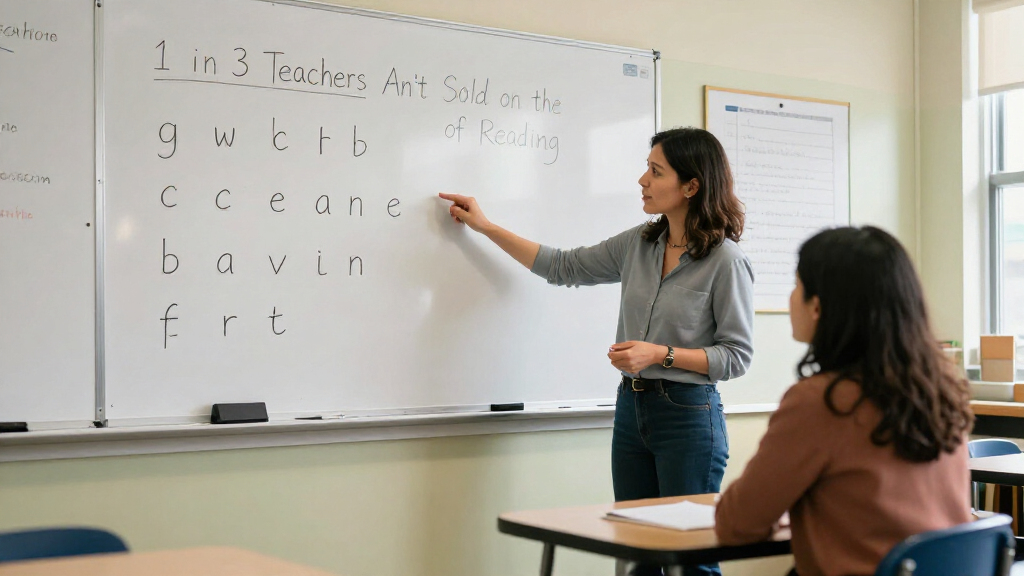
The 74 published a report titled “Why Nearly a Third of Teachers Aren’t Committed to the Science of Reading.” The source material provided here does not include the survey, its methods, the exact measure of teacher commitment or comments from respondents, so the size and meaning of the reported share cannot be independently assessed from it.
The 74 reported that nearly one in three teachers are not committed to the science of reading, a finding that raises questions about how consistently schools are adopting reading instruction associated with that approach. The source material provided for this article contains the report’s headline and a link, but not its underlying survey results, methods or teacher responses.
The report’s headline frames the finding as a lack of commitment among a substantial minority of teachers. The supplied material does not establish whether the figure came from a national survey, a smaller sample, interviews or another form of reporting. It also does not say when the data were collected or how many teachers were included.
The wording “aren’t sold on” describes an attitude, but the material does not define how the report measured that attitude. It is unclear whether respondents questioned the research behind the approach, disagreed with particular teaching practices, lacked training or materials, or simply did not say they were committed. Those are different situations and would call for different responses from schools and policymakers.
No direct quotations from teachers, researchers, district officials or the report’s authors appear in the source text supplied here. The article therefore cannot establish what respondents said about their reasons, nor can it determine whether the reported share reflects opposition, uncertainty or barriers to implementation.
Teacher Buy-In Shapes Reading Instruction
Teachers’ views matter because they put reading instruction into practice in classrooms. If a significant portion of educators are unsure about an approach, education leaders may need to understand whether the issue is a disagreement about evidence, inadequate preparation, limited classroom resources or another concern. The headline alone does not show which explanation applies.
The reported share may prompt questions for families and school communities about how reading is taught and whether teachers receive support to use the methods their schools promote. It is not, by itself, evidence that students are receiving ineffective instruction or that the reading approach has failed. Without the study details, readers cannot tell how widespread the finding is or whether it represents teachers across different grades, regions and school settings.
Products Worth Considering

Graco Modes Pramette 3-in-1 Stroller, Redmond

Owlet Dream Duo 3 Smart Baby Monitor System

LEGO Boost Creative Toolbox 17101 Robot Building and Coding Kit, 847 Pieces
As an affiliate, we earn on qualifying purchases.
What the Headline Does Not Explain
The science of reading is a label commonly used in education discussions about research on how children learn to read and the instruction associated with that research. The supplied report excerpt does not explain how its authors define the term, which instructional elements they included or what standard they used to classify a teacher as committed.
The source text consists largely of The 74’s website listings, links and promotional material. It identifies the report title and links to the article, but gives no survey question, sample description, results table or publication date for the report itself. The available information supports describing what The 74 reported in its headline, but not treating the percentage as a verified measure of all teachers’ views.
The source material does not include the survey instrument, sample size, sampling method or response rate. It also does not say whether “nearly a third” refers to teachers who rejected the approach, were unsure about it or selected a particular answer on a commitment question. The date and geographic scope of the data are not provided.
It is also unclear whether the reported finding was independently checked or whether the report contains additional evidence that qualifies the headline. No student reading outcomes or comparisons between classrooms are included in the supplied text. Those gaps limit what can responsibly be concluded about the finding’s reach and consequences.
Full Report Needed to Assess Finding
Readers seeking to evaluate the claim should consult the linked report for its data source, survey wording, methods and any explanation of teachers’ responses. Those details would show whether the finding describes a representative group and what “not committed” means in the report.
Until that information is available, the most defensible description is that The 74’s headline reports a teacher-attitude finding, while the supplied source text does not provide enough evidence to assess its scale or causes. No next survey, policy response or follow-up reporting is identified in the material provided.
Key Questions
What did The 74 report?
The 74 published a report with a headline saying nearly one-third of teachers are not committed to the science of reading. The source material provided here does not include the underlying results.
Does the source explain how teachers were surveyed?
No. The supplied text does not give a sample size, survey wording, response rate or sampling method, so the basis for the reported share cannot be assessed from it.
Does “not committed” mean teachers oppose the approach?
The source excerpt does not define the phrase. It does not show whether respondents opposed the approach, felt uncertain, or lacked training or resources.
What can readers conclude from the finding?
Readers can conclude that The 74 reported a finding about teacher commitment. Without the report’s methods and data, they cannot determine how broadly it applies or what accounts for teachers’ views.
Source: the74million.org