
📊 Full opportunity report: How Youth-Focused Vendors Can Manage Consent And Compliance on IdeaNavigator AI — validation score, market gap, and execution plan.

Get baby and family essentials delivered free — and shop member deals
- Fast, free delivery on millions of items
- Access to Prime Big Deal Days deals on October 6–7
- Prime Video, Amazon Music and more included
TL;DR
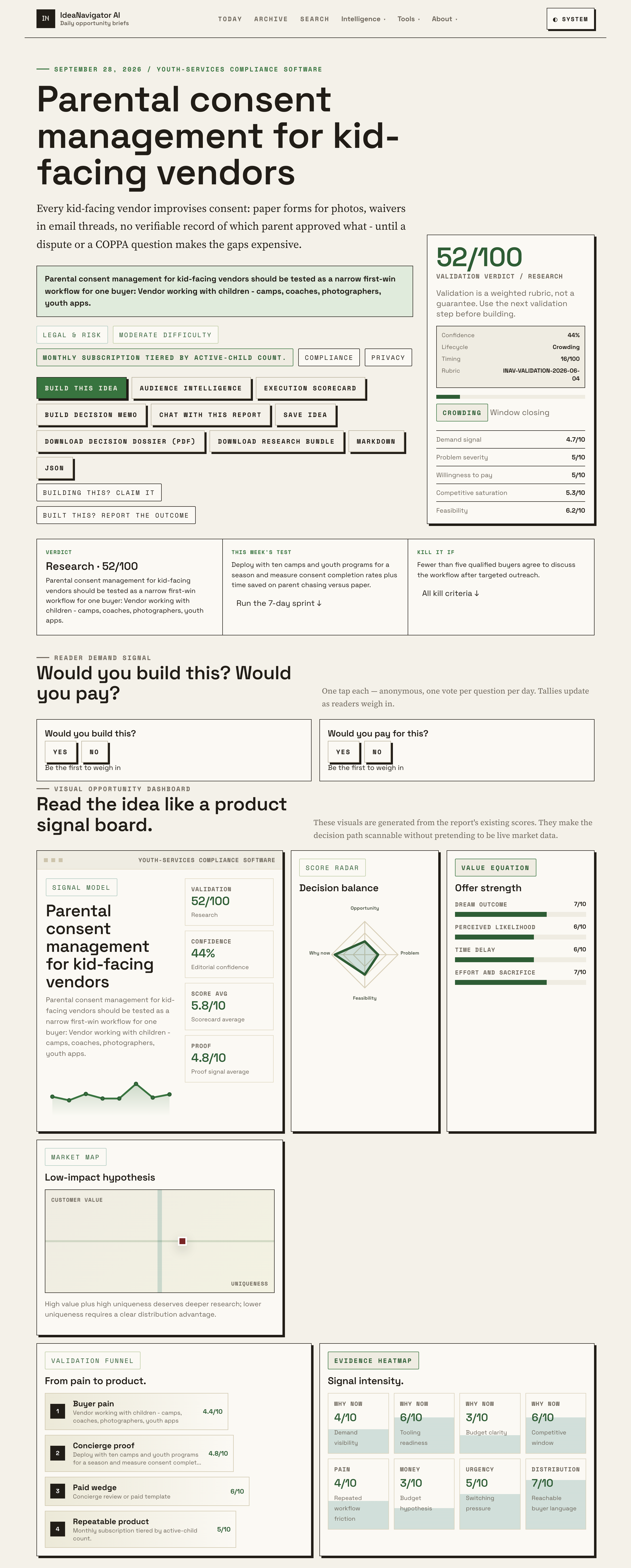
A proposed product concept would give camps, coaches, photographers and youth apps phone-based consent forms, per-child records and audit exports. The idea has not been reported as a launched service or tested product; its effectiveness and legal fit remain unverified.
The outline says the product would maintain a per-child consent ledger, track when approvals expire and let vendors export records for an audit. Its stated aim is to make it easier to establish which parent approved which use, and when. IdeaNavigator AI identifies gaps in that documentation as a potential source of difficulty during disputes or questions about compliance.
IdeaNavigator AI frames the first market as youth-services compliance software, with subscriptions priced by the number of active children. The proposal recommends testing the service with ten camps and youth programs over one season, measuring consent completion rates and staff follow-up time against paper processes. The source provides no evidence that this pilot has taken place.
Consent Records for Youth Programs
For organizations working with children, approval records can affect whether photos are shared, information is collected or a child can participate in an activity. IdeaNavigator AI’s proposal argues that searchable records could help staff answer parents’ questions and locate approvals when a dispute arises. These are potential benefits of the proposed workflow, not demonstrated outcomes: the source reports no completion-rate data, time savings or customer results.The concept also points to a trade-off for small vendors. A centralized system may reduce manual follow-up, but it would add a recurring cost and require staff to maintain accurate child and parent records. Whether vendors would adopt it may depend on whether it fits their existing enrollment process and handles the types of consent they actually need.
From Paper Forms to Digital Logs
IdeaNavigator AI’s proposal describes a pattern in which photo releases are on paper, waivers are in email threads and vendors lack a single record showing which parent approved which use. It argues that this can leave vendors struggling to document consent when a parent raises a concern or a compliance question arises. The source includes no survey or independent measurement of how widespread the practice is.IdeaNavigator AI cites COPPA updates, state laws and growing parent scrutiny as reasons the issue may be receiving more attention. The outline does not identify particular laws, effective dates or enforcement actions, so it does not establish which requirements would apply to a specific camp, coach, photographer or app. Vendors would need to assess their own obligations based on their activities and location.
Pilot Results and Legal Fit
The information provided by IdeaNavigator AI presents the product as a proposal. It is unclear whether a product has been built, whether ten programs have agreed to participate, or when a pilot might begin. The source reports no results on consent completion, staff time saved, subscription demand or parent response.Several design questions are also open: how the service would verify a parent’s identity, how it would handle disputes over guardianship, and how it would protect sensitive records such as medical details. The outline does not show how its forms would meet the different legal requirements that may apply across jurisdictions or consent types.
Testing Across a Program Season
IdeaNavigator AI proposes a seasonal pilot with ten camps and youth programs. The stated measures are parent consent completion rates and the time staff spend chasing approvals compared with paper-based processes. The outline supplies no schedule, recruitment status or evaluation method.If a pilot proceeds, those results could help determine whether vendors find the workflow useful and whether the subscription model fits their budgets. Until results or product details are available, the concept’s practical performance and compliance coverage remain unconfirmed.
Source: IdeaNavigator AI proposal
Key Questions
Has a parental consent product launched?
No launch is reported in the available information. IdeaNavigator AI describes a proposed product concept.
Who is the proposed service for?
The concept targets vendors working with children, including camps, coaches, photographers and youth apps.
What would the proposed workflow include?
It would offer phone-based forms for photo, data, medical and liability consent, plus per-child records, expiry tracking and audit exports. The details of identity verification are not specified.
Has the proposed pilot produced results?
No. A seasonal test with ten camps and youth programs is proposed, but no enrollment or measurement results are reported.
Source: IdeaNavigator AI
Fall Picks
fall essentials
As an affiliate, we earn on qualifying purchases.